From Childhood to Cinema: An Interview with Acclaimed Filmmaker Silvio Caiozzi
Simple, yes, very simple is the man of celluloid and frames. He often smiles, talks and reflects... Then he talks again and he’s interesting.
A decade ago, he transformed his childhood home into his production company, Andrea Films, where he now works in both cinema and advertising. In both fields, he is highly successful, being one of the most awarded filmmakers in Ibero-America. And it's no surprise—his feature films, Julio Begins in July (1979), The Moon in the Mirror (1990), Coronation(2000), Cachimba (2004) and the documentary Fernando Has Returned (1998), have received significant accolades at the most prestigious international film festivals.
In Chile, his advertising work is also remembered for the first commercial to win an award abroad. El Indio Firestone, starring Luis Alarcón, won the Golden Lion at the Cannes Film Festival in France (1986).
In the foyer of Andrea Films, a marble cover and a display case proudly showcase his awards because Silvio Caiozzi continues to thrive. Two months ago, the Chamber of Deputies awarded him the "Recognition for the Creation and Development of the National Cinematographic Industry."
Caiozzi has much to show, and his Italian heritage from his grandparents, who arrived in Chile from the village of Chianni in Tuscany, is evident. At the end of the 19th century, they set up a store on Franklin Street. Later, Silvio's father discovered how to preserve condiments in vinegar without refrigeration. Thanks to his ingenious formula, the shop turned into a food barrel factory and eventually employed sixty workers.
In his early years, Silvio lived on Serrano Street before moving to Pedro de Valdivia Avenue, where his parents enrolled him in KENT.
The Cinephiles’ Group
What’s unique about Andrea Films is the marble. We ascend a marble staircase while I balance a hot coffee that’s about to spill. Immediately, a statue of St. Francis of Assisi and several promotional posters of his films guide me to his office. We’ve arrived; now the journey into the past begins...
"I entered the school in the second year of humanities because I was previously at a very small establishment that didn’t cover all of secondary education... My family and I lived on Serrano Street and then moved to this house, so KENT was very close."
His green eyes sometimes turn yellow, contrasting with his hair, which is somewhat tangled with strands of white and black.
Given your rather shy personality, what were your initial impressions of your new school?
I remember seeing KENT as a large school compared to my previous one. It was a huge shock for me, very aggressive. It was all boys and very few girls. For the first two years, I was in the corners, barely spoke, and was frightened by my classmates pushing each other and all these aggressive games I had never seen before.
Was the class unruly, studious—how do you recall it?
Oh, they behaved terribly, just terribly! (He smiles like a child, very spontaneously). It was a very difficult class. I was a good student, quiet, not a nerd, but Mr. Tarragó had serious problems with us; he often gave us several lectures. However, the curious thing is that despite being a group with serious behavioral issues, by the last year, we became a very good class with excellent grades, especially in the baccalaureate, where the results were very high. In fact, many of us became successful professionals.
Besides yourself, can you name a few others?
Mario Manbor, a prominent surgeon; Carlos Schlesinger, who continued with his father’s company dedicated to paints, inks, and chemicals; people who worked at the Inter-American Development Bank in Washington; Roberto Mosse, for example, my best friend and desk mate, who is now retired and lives in Washington. Similarly, Miguel Schloss also worked for the bank in that city.
In that mischievous and turbulent atmosphere, how did you build your friendships?
Since I was quite shy, I formed a small group of five or six friends, and we always gathered to chat. We mostly talked about the movies we had seen over the weekend. I told them the stories with such pleasure that when they went to the cinema, they would say, “Hey, I liked your story more than the movie.”
During the conversation, Silvio frequently smiles. Gradually, he recalls those old times with enthusiasm. It’s about four in the afternoon, and from his office window and terrace, many Kentians can be seen heading home.
Was that the moment your enthusiasm for filmmaking began?
No, I had been interested from a very young age, but I didn’t know I would become a professional; I never thought about it, it was more like a hobby. For instance, with this group of KENT friends, I would make them act. I have a film here that I shot with an eight-millimeter camera and a projector. I edited and even acted in it myself. We spent every weekend here at my house filming. The scripts were adapted from comic strips; they were short pieces of five or six minutes.
An Education of Openness and Respect
After graduating from KENT, Silvio spent some time helping in his parents’ factory and then traveled to the United States, where he graduated with a Bachelor’s degree in Mass Communication Arts from Chicago (1967). Although his school memories are not the freshest, he has no trouble naming his teachers:
"I remember Mr. Tarragó, Mr. Mengod, Salvador, the painter Carlos Osandón..."
What about Professor José Donoso? You collaborated with the famous writer on the script for your film The Moon in the Mirror, Coronation, and his novel of the same name, and Cachimba inspired by the work Still Life with Pipe.
When I entered KENT, he had just finished teaching there. I never saw him, but the coincidence is that Mr. Mengod taught us Chilean literature, which we all found very dull, but among the books he gave us was Coronation. It was the only book I read twice, which was unusual because I didn’t like reading. I was hooked... Over the years, I made the film.
And what about the founder, Don Alejandro Tarragó? What was the message he conveyed to all his students?
He was incredibly cultured. He knew everything—literally everything. He could replace any teacher in any subject; he was very didactic. He taught you to take things seriously and to learn to listen. He was a great rector, and all the students I’ve spoken with have an exceptional image of him.
One of his great qualities was his objectivity and his focus on quality. He didn’t have any biases and always taught us to “not follow the herd,” to be individuals who respect the good in others. Essentially, he respected quality and was very open-minded, even considering the situation he had to live through in Spain.
How did this education based on openness and respect influence your class?
Not just respect, but we were instilled with the idea of learning more and taking things seriously because, in school, you acquire the tools for what you want to be in the future. In my class, we all ended up as distinguished professionals, generally, very satisfied with our lives, and that’s thanks to KENT.
With this concept of openness and respect for everything, it’s not surprising that my class produced notable professionals in entirely diverse fields. In my class, you find everything, even a filmmaker (he jokes). This indicates that everyone chose what they truly liked without following any particular banner.
When was the last time you saw your class?
Well, it was when we had our fortieth reunion in 2002. Roberto Mosse started sending emails and organizing it. Former students from various parts of the world, like the United States and Australia, came, with ninety percent of the class present. We celebrated for four days, including the ladies!
It was very emotional; some I didn’t even recognize because they had changed so much. We started the reunion at Stade Francais, and as a gift, I showed them the film we had made at my house—they were laughing so hard.
The next day, we gathered at KENT for the end-of-year party. I was asked to give the speech, they said, "You’re the artist," and they "teased" me (he smiles). The following day, we went to Santo Domingo.
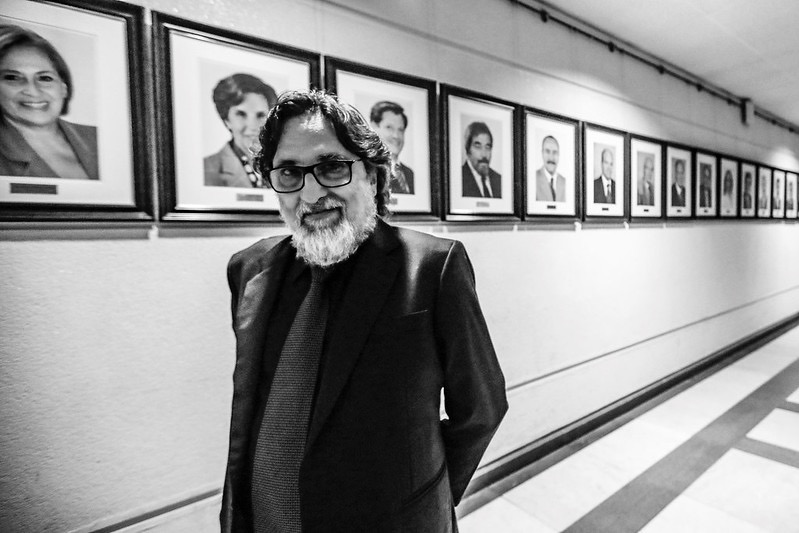
His friends are right. Silvio Caiozzi is indeed an artist, modest yet grand. On the balcony, Silvio poses for a photo where the KENT building is faintly visible. The photo turns out poorly. Silvio gives me instructions, then takes the camera and reviews it... It’s inevitable, he takes his position, shows patience—I’m not very tech-savvy. I adjust the frame, the angle, and suddenly, I feel like part of a trailer.
Publicar un comentario